•     marker--v2 302, B - Wing, 3rd Floor, Pinnacle Corporate Park, Bandra Kurla Complex, Bandra East, Mumbai - 400051
Key Highlights

Industry-Recognized Certification
Certification from G-TEC Jain Keerti with strong industry relevance
Expert Faculty
Expert Faculty
Training delivered by experienced Data Scientists, AI Professionals, and Industry Experts
Hands-on Learning
Hands-on Learning
100% practical training with real-world datasets, coding assignments, and case studies
Comprehensive Curriculum
Covers Python, Statistics, Machine Learning, Deep Learning, NLP, and AI
Real-Time Tools Exposure
Training on Python, Google Colab, NumPy, Pandas, Matplotlib, Seaborn, and Scikit-learn
Career Support
Career Support
Job assistance, resume building, and interview preparation sessions

About the Course

Builds a strong foundation in Data Science, AI, and Machine Learning

Builds a strong foundation in Data Science, AI, and Machine Learning with a practical approach

Covers Python programming along with data analysis

Covers Python programming along with data analysis using NumPy and Pandas

Includes data visualization techniques

Includes data visualization techniques using Matplotlib and Seaborn

Provides hands-on experience with machine learning algorithms

Provides hands-on experience with machine learning algorithms like regression, classification, and clustering

Covers advanced topics

Covers advanced topics such as Deep Learning, NLP, and Time Series Analysis

Content

This program is designed to cover the complete Data Science lifecycle, starting from fundamentals, statistics, and Python programming. It includes data analysis using NumPy and Pandas along with data visualization through Matplotlib and Seaborn. Learners gain practical exposure to machine learning, advanced AI concepts like deep learning, NLP, and time series analysis. With hands-on Assignments tools like Google Colab, Git, and SQL, the course ensures industry-ready skills.

  • Introductions to Data Science
  • Domains in Data Science
  • Need of Data Science
  • Use of Data Science in Business
  • Lifecycle of Data Science Projects
  • Data Science Tools and Technologies
  • Basics of Excel for Analysis
  • Required Skill for Data Science

  • Types of data
  • Descriptive vs Inferential Statistics
  • Sampling Techniques
  • Measures of Central Tendency and Dispersion
  • Hypothesis & Inferences Testing
    1. 1 . F Test
      2 . T Test
      3 . ANNOVA
      4 . Chi Square Test
  • Confidence Interval
  • Central Limit Theorem
  • P value
  • Variables
  • CoVariance and Corelation

Supervised

  • Linear Regression / Multi-Linear Regression
  • Logistic Regression
  • Gradient Descent
  • Decision Tree (CART)
  • Random forest (Ensemble Learning) // Boosting /Bagging
  • K Nearest Neighbors (KNN)
  • Support Vector Machine (SVM)
  • Naive Bayes Classifier (NBC)
  • GRID SEARCH CV AND RANDOM SEARCG CV

Unsupervised

  • Hierarchical Clustering / Dendrograms
  • K Means Clustering
  • DBSCAN
  • MINI BATCH K MEANS

Dimension Reduction Models

  • PCA
  • Kernal PCA

TIME SERIES ANALYSIS

  • ARIMA
  • FB PROPHET

AI

  • ANN
  • Simple ANN Model

CNN

  • Transfer Learning (VGG16 / VGG 19 / RESNET 50 / Inception V3)

NLP

  • 2 BAG of words(count vectorization)
  • 3 TD-IDF-term frequency inverse document frequency
  • Introduction to Python
  • Command line basics
  • Numbers, Operators & Comments
  • Variables & Strings
  • Boolean & Conditional Logic
  • Looping in Python
  • Lists
  • Dictionaries
  • Tuples & sets
  • Functions & Adv Functions
  • Modules
  • OOP
  • File I/O

  • Introduction to NumPy and Creating NumPy Arrays
  • Basic Operations on Arrays
  • Indexing and Slicing
  • Reshaping, Stacking, and Splitting
  • Iteration, Filtering, and Boolean Indexing
  • Image Processing Using NumPy and Matplotlib

  • Data Structures in Pandas
  • Creating Data Frames and Loading Files
  • Data Exploration (EDA)

  • Seaborn Installation
  • Introduction to Seaborn
  • Basics of Plotting
  • Plots Generation
  • Visualizing the Distribution of a Dataset
  • Selection color palettes

Visualisation with Matplotlib

  • Matplotlib Installation
  • Matplotlib Basic Plots & it's
  • Containers
  • Matplotlib components and
  • properties
  • PyLab & Pyplot
  • Scatter plots
  • 2D Plots
  • Histograms
  • Bar Graphs
  • Pie Charts
  • Box Plots

This module aims to equip students with comprehensive knowledge and practical skills in Artificial Intelligence (AI). Students will explore key AI concepts, methodologies, and tools for developing intelligent systems. The curriculum includes essential algorithms, data preprocessing methods, and model evaluation strategies. Additionally, students will gain hands-on experience with popular programming languages and frameworks used in AI application and software development.

  • Introduction To AI
  • Why AI is Required
  • What is Neuron
  • Architecture of Artificial Neural Network
  • Neural Network Modules
  • Activation Functions
  • Optimization Function
  • Cost function
  • Dense Neural Network
  • Regularization
  • Gradient Descent

  • Simple ANN Model

Image Classification

  • Basic Intro to CNN
  • CNN (Convolution Neural Network)
  • CNN Architecture Building
  • Transfer Learning (VGG16 / VGG 19 / RESNET 50 / Inception V3)

NLP (Natural Language Processing)

  • Basic Intro to NLP
  • Simple NLTK (stemming, lemmatization, regex, stop words, corpus, unigram, bigram,trigram)
  • BAG for words (count vectorization)
  • TD-IDF-term frequency inverse document frequency
  • Word embedding:
    1. . GloVe
      . Word2Vec
      . FastText
      . Keyed Vector
      . TextBlob

Machine Learning (ML) is a subset of Artificial Intelligence that focuses on enabling computers to learn from data and make predictions or decisions without explicit programming. It encompasses supervised, unsupervised, and reinforcement learning, with applications, spanning Healthcare, Finance, Retail, Manufacturing, Telecommunications, Agriculture, Energy, Transportation, Education, and Entertainment industries.

Key aspects include various algorithm types, feature engineering, model evaluation, overfitting, and ethical considerations. The field is dynamic, emphasizing continuous learning and innovation across multiple industries.

Supervised Learning

  • Linear Regression / Multi-Linear Regression
  • Logistic Regression
  • Decision Tree (CART)
  • Ensemble Learning
  • Random Forest
  • XGBoost
  • K-Nearest Neighbors (KNN)
  • Support Vector Machine (SVM)
  • Naive Bayes Classifier (NBC)
  • Grid Search CV and Random Search CV
  • Linear Discriminant Analysis (LDA)

Unsupervised

  • Hierarchical Clustering / Dendrograms
  • K-Means Clustering
  • DBSCAN
  • MINI BATCH K-Means

Metrics

  • MAE / MSE/ RMSE / R2 and Adjusted R 2
  • AUC ROC CURVE / Precision / Recall / F1 score / Confusion Metrics

Dimension Reduction Models

  • PCA
  • Kernal PCA

TIME SERIES ANALYSIS

  • ARIMA
  • FB PROPHET

Hyperparameter Tuning / Advanced ML Models

  • Over fitting and underfitting
  • Cross Validation
  • Log Loss
  • Elastic net
  • Lasso and Ridge Regression
  • SMOTE
  • SKLEARN Using Hyperparameter
  • Model Evaluation
  • Gradient Descent

  • Introduction to Git & Distributed
  • Version Control
  • Git Life Cycle
  • Create Clone & Commit Operations
  • Push & Update Operations
  • Stash, Move, Rename & Delete
  • Operations
  • Charts and Graphs
  • Dashboard Creation

  • Selecting & Retrieving Data with SQL
  • Filtering, Sorting and Calculating Data With SQL
  • Subqueries and joins in SQL
  • Modifying and Analyzing Data With SQL

  • 1. House Price Prediction Using ML Models
  • 2. Credit Card Defaulter using ML Models
  • 3. Products of Electronics using ML Models
  • 4. Revenue of the company using ML Model
  • 5. Sales of the product using ML Model
  • 6. sales of flowers using ML Model
  • 7. Case study on Sales Forecasting and market analysis
  • 8. Plants Diseases using Image Classification
  • 9. Malaria diseases using Image classification
  • 10. Sentiment Analysis using NLP

Learners Outcome

G-Tec Jain Education Learners Outcome
  • Proficiency in collecting, cleaning, and preprocessing data, including handling missing values and outliers.
  • Skilled in Python, utilizing libraries like NumPy and Pandas for data manipulation and analysis.
  • In-depth understanding of various ML algorithms, including regression, classification, clustering, and dimensionality reduction.
  • Proficiency in improving model accuracy
  • Understanding the impact of features on model performance, including feature selection and engineering, to enhance accuracy
  • Proficient at creating informative visualizations using Matplotlib and Seaborn.
  • Effective communication of insights through charts and graphs.
  • Capable of independently and collaboratively solving complex data problems

Career Outcome

    After completing the course, learners can confidently pursue roles such as:

  • Data Analyst
  • Junior Data Scientist
  • Machine Learning Engineer
  • Data Scientist
  • Senior Data Scientist
  • Data Science Consultant
  • Machine Learning Researcher
  • The program aligns with India’s fast-growing Data Science & AI job market, offering strong salary and career growth potential.

G-Tec Jain Education Career Outcome

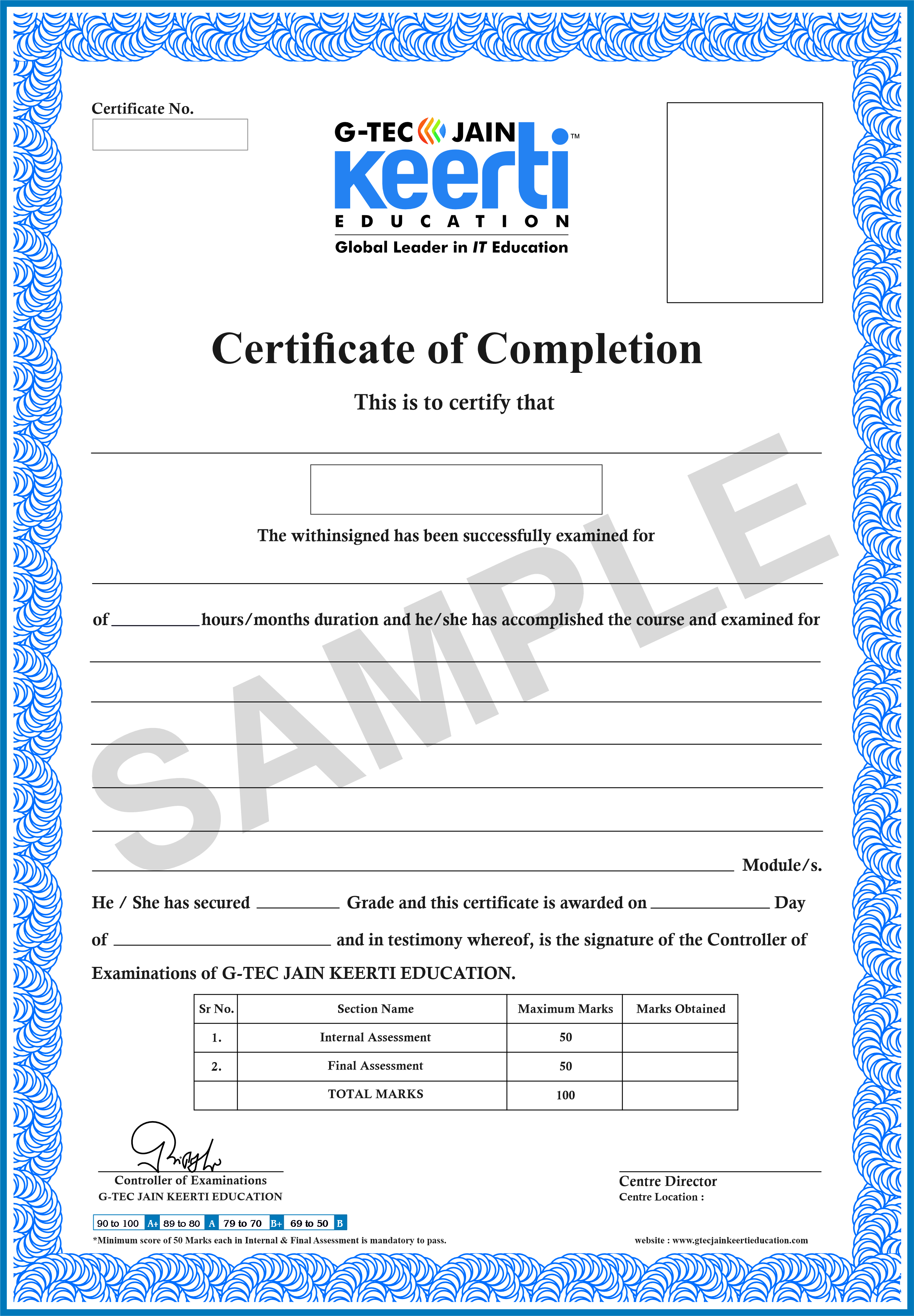
Certificate

    • GJK:The Data Science Certificate provided by the G-TEC JAIN Keerti is a prestigious recognition awarded to individuals who successfully complete their data science courses. This certificate serves as a confirmation of your expertise and competence in the field of data science
    G-Tec Jain Education


Our Affiliations & Associations

We believe people are at the centre of every solution, leading us to the right solution just waiting to be delivered.


G-Tec Jain Education abma-education
G-Tec Jain Education acca
G-Tec Jain Education ac-council
G-Tec Jain Education adobe-certified
G-Tec Jain Education aie
G-Tec Jain Education autodesk
G-Tec Jain Education certiport
G-Tec Jain Education esb
G-Tec Jain Education iaap
G-Tec Jain Education
G-Tec Jain Education iab
G-Tec Jain Education iibi
G-Tec Jain Education information-technology-specialist
G-Tec Jain Education jain
G-Tec Jain Education media-intertainment
G-Tec Jain Education microsoft-office-specialist
G-Tec Jain Education niekit
G-Tec Jain Education nsdc
G-Tec Jain Education pmi
G-Tec Jain Education prometric
G-Tec Jain Education quick-books
G-Tec Jain Education rasci
G-Tec Jain Education sap
G-Tec Jain Education sap-partner
G-Tec Jain Education sap-student-academy-program
G-Tec Jain Education tally
G-Tec Jain Education uk


TESTIMONIALS OF DATA Science with ML and AI COURSE

Frequently Asked Questions

  • This course is ideal for students, working professionals, and career switchers aiming to build a career in Data Science, AI, or Machine Learning.
  • Basic computer knowledge is required. Prior exposure to Excel or programming is helpful but not mandatory.
  • The program is highly practical, with hands-on coding, live projects, and real business case studies.
  • Python, Google Colab, NumPy, Pandas, Matplotlib, Seaborn, SQL, Scikit-learn, Git, ML & AI frameworks.
  • Yes. Learners receive an industry-recognized certificate from NSDC, G-TEC JAIN Keerti, and JAINX University.
  • Yes. The program includes career guidance, interview preparation, and job assistance support.


Interested In Course

Download the Brochure by filling the form below